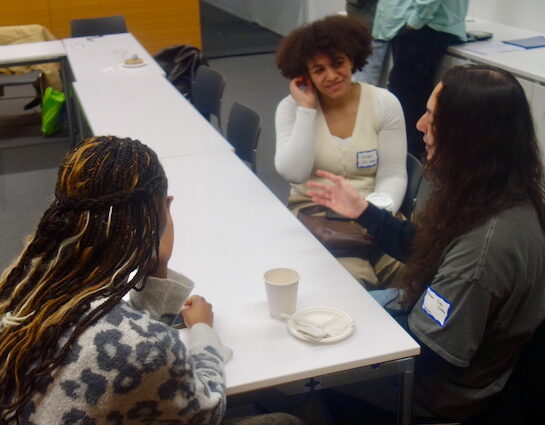
Earlier this year, we hosted our first Cardiovascular Inquiry Panel of the year. These sessions with students from the Cleveland School of Science and Medicine give them access to individuals at different stages of the Edwards pathway and allow them to ask candid questions about what it actually requires to become a physician.
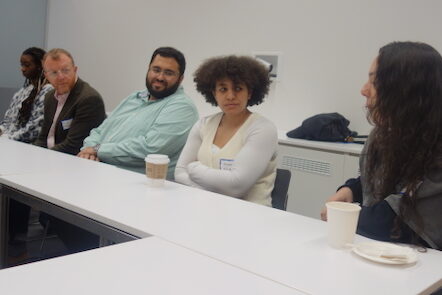
The panel reflected a clear progression. Dr. Suhib Jamal, a former Edwards Scholar who now practices as a pediatrician, spoke from the perspective of someone who has completed the full arc of training. Two current undergraduate Edwards Scholars Esther Umezurike-Chukwu and Fabian Diaz Cuadra described the demands of college as they are experiencing them now. This year’s newly selected scholar Morgen Rosario shared her experience in preparing to begin at Case Western Reserve University.
From the first questions, it became clear that the students attending were not simply looking for advice or reassurance; they were looking for clarity. They asked how to balance mental health with academic rigor. They asked how to manage time when professors assign little daily homework and no one monitors study hours. They asked how to approach senior year once college applications are submitted.
“The academics were fine. The hard part was feeling like I didn’t belong. You want to be somewhere you can make friends and not feel alone for your whole education.” – Morgen Rosario, Edwards Scholar (Reflecting on an Elite Summer Program)
Listening to the discussion among past and present Edwards Scholars and the students gathered in the room, one thing became evident: our role is not primarily to inspire. It is to clarify. Over more than fifteen years, Edwards Scholars have become the most valuable expression of the program. From practicing physician to undergraduate to incoming freshman, the scholarship is now producing something more powerful than financial support. It is producing examples. And examples illuminate the path forward.
Here are several key takeaways from the panel.
Admission Is a Starting Point
We often think about the challenges students face on the long educational pathway to a medical career. For first-generation medical students, and in some cases first-generation college students pursuing any advanced degree, the hill can appear even steeper and the route less defined. Yet seminars like this consistently reveal something different. Where adults sometimes see obstacles, students often see opportunity. Where we anticipate barriers, they see doors waiting to be opened.
Throughout the discussion, a distinction kept resurfacing: the difference between being admitted to college and being prepared to succeed there.
In many academic environments, admission to a selective institution becomes the goal. Acceptance letters are treated as proof that the work has paid off. For students pursuing medicine, that framing can be incomplete. Admission opens the door. It does not determine what happens once a student walks through it.
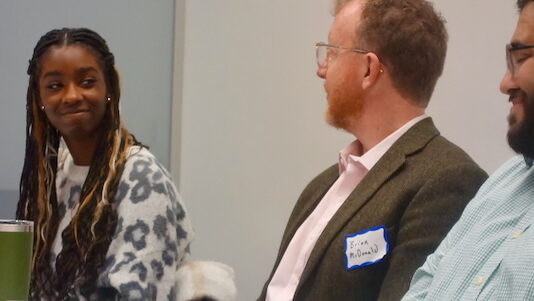
The undergraduate scholars spoke candidly about how different college feels from high school. In high school, structure is largely external. Assignments are frequent. Teachers monitor progress. Expectations are reinforced daily. In college, particularly at an academically rigorous institution, that structure shifts inward. Some courses assign little daily homework. Office hours are optional. No one checks whether you are studying. Students must build their own routines and manage unstructured time intentionally.
“In high school, someone is always checking on you. In college, no one checks if you studied. You have to build your own routine.” – Fabian Diaz Cuadra, Edwards Scholar
The conversation also addressed belonging. One panelist described attending a summer program at an elite institution and feeling socially isolated despite strong academic performance. Another reflected on the importance of finding a campus community where she could exist comfortably while still being challenged. Prestige without belonging can undermine performance.
Senior year of high school, they emphasized, should not be treated as a victory lap. Colleges request midyear and final transcripts, but more importantly, the habits formed during that year often determine how well students adapt once they are on campus. Rigor, time management, and the willingness to ask for help early are stronger predictors of long-term success than the name of the institution on an acceptance letter.
For students considering medicine, admission is not the culmination of effort. It is the beginning of a more demanding phase.
Learning How to Learn
Another consistent thread was humility and the understanding that for physicians, learning never stops.
Dr. Jamal described moments in practice when he has paused during a patient encounter to confirm information before finalizing a treatment plan. Confidence, he explained, does not mean having every answer immediately. It means recognizing when additional verification is needed and taking responsibility for it. In medicine, the inability to admit uncertainty can be more dangerous than the need to consult a resource.
The undergraduate scholars echoed this in their own experience. One spoke about discovering that visiting office hours strengthened both her understanding and her relationships with faculty. Another reflected on how asking a question in a study group often revealed that others were wrestling with the same material. Silence may protect pride in the short term, but it slows growth over time.
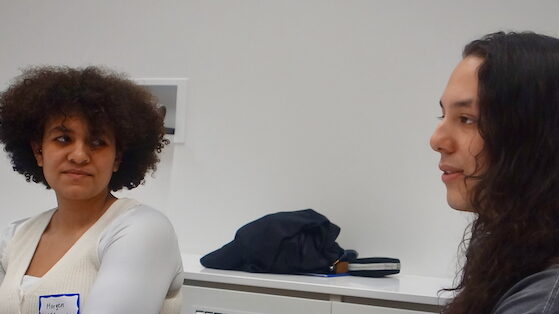
“Everything is reliant on you. You have to figure out what routine works for you — when you study best, what environment helps you focus. No one builds that for you anymore.” – Esther Umezurike-Chukwu, Edward Scholar
Preparation for medicine extends beyond mastering content. It includes developing self-awareness, disciplined routines, communication skills, and the confidence to seek support. These habits compound across years of training and ultimately shape professional competence.
Exposure Builds Ownership

After the formal discussion concluded, students gathered around Dr. Jamal to practice taking blood pressure. They positioned the cuff, listened for the reading, and interpreted the numbers.
The procedure itself was simple, but the shift was meaningful. Observing a profession is different from participating in it, even briefly. When students moved from listening to doing, the work felt more tangible.
Dr. Jamal also pointed out the importance of monitoring blood pressure in the communities where many of these students live. Hypertension is common, treatable, and often undetected. Early awareness and routine monitoring can change outcomes. In that moment, the lesson moved beyond career exploration. It became a community responsibility. Learning the skill was not just practice for a future profession. It was preparation to serve the neighborhoods that shaped them.
Exposure provides information. Participation builds ownership. Ownership strengthens commitment.
The Real Payoff of a Medical Education
When asked what sustains them through a process that can extend more than a decade, the answers were measured and direct.
Dr. Jamal described a recent encounter with a child experiencing an asthma attack. He explained assessing the situation, recognizing when in-office treatment was insufficient, coordinating emergency care, and later seeing the patient return stable and improving. The reward, he noted, is not abstract prestige. It is the integration of analysis, communication, and witnessing measurable improvement in another person’s life.
“Every step gets harder. College is hard. Medical school is harder. Residency is the hardest. But each stage builds on the one before it.” – Dr. Suhib Jamal
The undergraduate scholars articulated similar motivations. One spoke about serving the communities that shaped her. Another described intellectual curiosity and the desire to continue learning at the highest level. A third reflected on a simple truth: time moves forward regardless. The more meaningful question is how one chooses to invest it.
Clarity as Preparation
The seminar did not revolve around dramatic inspiration. It centered on realism. When students are given a clear and honest picture of the work ahead, they do not retreat from it. They engage it thoughtfully. They ask better questions. They begin to see themselves within it.
For the Foundation, this reinforces an important responsibility. Our work does not end with helping students secure admission. It extends to helping them understand what follows and to develop the internal capacity required to meet it.
The pathway to medicine is long and exacting. It requires humility, resilience, disciplined independence, and sustained effort. Clarity about that reality does not discourage students. It equips them.
Over time, as each cohort progresses from high school to college to practice, clarity becomes continuity. Continuity becomes mentorship. Mentorship becomes a visible and navigable pathway where none previously existed.
Beyond admission lies the real work. Our commitment is to ensure that students are not only admitted, but prepared to walk that road with confidence, purpose, and the capacity to serve the communities that first believed in them.

0 Comments