Every scholarship has a story.
Some begin with a generous donor. Others begin with an extraordinary student. The Joan C. Edwards Scholarship began with something different: a question.
How do you help talented young people see themselves in places they’ve never imagined they belong?
For Dr. Robert Haynie, that question has guided more than five decades of work in medical education.
When Haynie arrived in Cleveland as a graduate student in 1967, he was struck by a contradiction. Case Western Reserve University sat in the heart of the city, surrounded by neighborhoods full of talented young people. Yet very few students from those neighborhoods found their way onto campus.
“What I noticed was there was nobody who looked like me on that campus. I said, ‘Wait a minute. How could a university with a bus that goes right down Euclid, where people get off right there, have nobody from those neighborhoods going to the school?’ I thought that was shocking.”*
That observation became more than a passing thought. It became a lifelong mission.
As Haynie continued his own journey through graduate school, medical school, and eventually into leadership at Case Western Reserve University School of Medicine, he never lost sight of the opportunity that existed just beyond the university’s walls. Within a single walk through University Circle were some of the world’s leading educational, medical, and cultural institutions. The challenge wasn’t a lack of opportunity. It was building a pathway that connected local students to those opportunities.
Years later, that opportunity arrived with the creation of the Cleveland School of Science and Medicine.
Rather than beginning with scholarships or financial aid, Haynie and the school’s leadership focused on something more fundamental: relationships.
“If you want to start pipelines, you’ve got to first build bridges. We’ll have your students come to the medical school. They’ll get to know us. We’ll get to know them. Maybe we can cultivate a pipeline.”
That philosophy also resonated with the Joan C. Edwards Charitable Foundation.
When Foundation leaders learned about the partnership taking shape between the Cleveland School of Science and Medicine and Case Western Reserve University, they recognized that the commitment was already there. Rather than creating a new program, they chose to strengthen one that had already been built on relationships, mentorship, and a shared belief in students’ potential.
Haynie believes that sequence matters.
“There’s the two C’s: cash and commitment. If cash comes before commitment, once the cash runs out, the commitment ends. If commitment comes before cash, you’ll have longevity.”
The Foundation’s investment helped transform that commitment into one of the country’s most distinctive medical education pathways. Through the Edwards Scholarship, students receive the financial support, mentoring, and encouragement needed to pursue medicine without the burden of overwhelming educational debt.
The results speak for themselves.
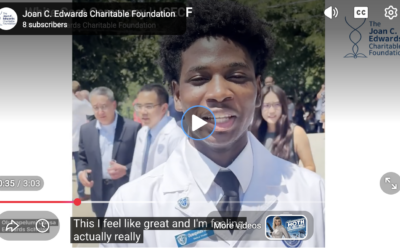
For decades, students from the Cleveland Metropolitan School District rarely found their way into Case Western Reserve University School of Medicine. Today, Edwards Scholars such as Dr. Nichelle Ruffin, Dr. Suhib Jamal, and Dr. Nichola Bomani Gonzalez have completed medical school and entered careers in family medicine, pediatrics, and obstetrics and gynecology.
For Haynie, those graduates represent more than individual success stories.
“From 1990, we had nothing—the dry zone. Now we’ve shown that you can take kids from the City of Cleveland, put them in the best environment with the best teachers and family support, wrap them with the university and the medical school, and they become physicians.”
Just as importantly, they become examples for those who follow.
“You can’t be what you don’t see. You need to see it. If one student from Cleveland can become a physician, then another student can begin to believe, ‘Maybe I can do that too.'”
Looking back over his career, Haynie says helping create that pathway has become his proudest accomplishment.
“People said it couldn’t be done. They said these students weren’t going to come to Case. But it shows that they can do it.”*
The Edwards Scholarship was created to remove financial barriers to a medical education. Along the way, it has done something even larger. It has demonstrated what is possible when schools, universities, philanthropists, mentors, and families commit to students long before they submit a college application.
The pipeline is visible today in the physicians serving patients across the country.
But as Dr. Haynie reminds us, every pipeline begins with a bridge.
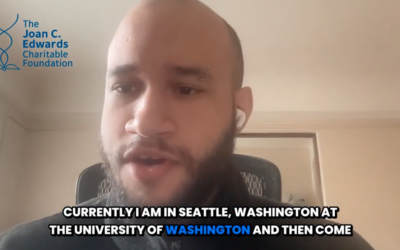
Watch Dr. Robert Haynie share the remarkable story behind the philosophy that continues to shape the Edwards Scholarship Program—and why building bridges has always come before building pipelines.

0 Comments